Communicable · Medium priority
Poliomyelitis
Core disease facts with the linked government programme, prevention and treatment or cure reality.
TypeViral disease — caused by poliovirus.
Image-based identification
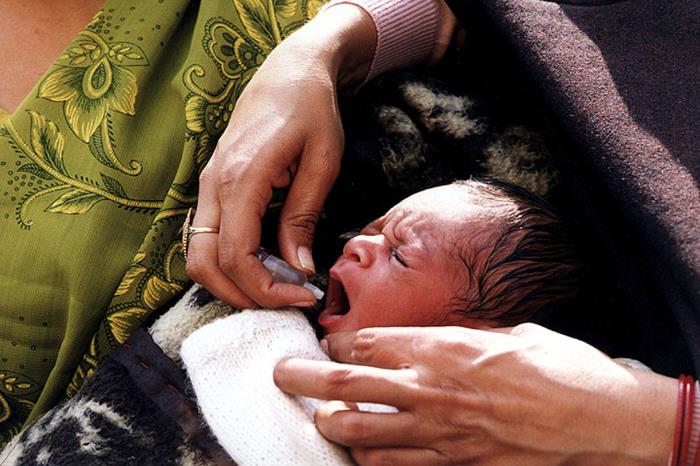
Government programmes, schemes and services
- Programme: Universal Immunisation Programme: Provides oral and inactivated polio vaccine doses to maintain population immunity and prevent poliovirus transmission.
- Campaign: Pulse Polio Programme: Gives oral polio vaccine to all eligible young children on National and Sub-National Immunisation Days, regardless of previous doses.
- Surveillance: Acute flaccid paralysis and environmental surveillance: Searches for possible poliovirus in paralysed children and sewage so any importation or circulation can be detected rapidly.
Prevention
- Prevent: Oral Polio Vaccine and Inactivated Polio Vaccine, high coverage, sanitation, immediate investigation of Acute Flaccid Paralysis
Treatment and cure reality
- Treat: No cure for established paralysis. Supportive care, respiratory support when needed, physiotherapy and rehabilitation.
Must remember
- Spread: Poliovirus spreads mainly by the faeco-oral route.
- Key ratio: About 1 in 200 infections causes irreversible paralysis.
- Typical paralysis: Acute flaccid, asymmetric paralysis with preserved sensation.
- Vaccines: Oral Polio Vaccine produces strong intestinal immunity; Inactivated Polio Vaccine is injectable and cannot cause vaccine-derived infection.
- India milestone: Last wild-poliovirus case was reported on 13 January 2011; the World Health Organization South-East Asia Region was certified polio-free in 2014.
- Surveillance continues: Acute Flaccid Paralysis and environmental surveillance remain necessary because certification does not remove importation risk.