Emergency · High priority
Snakebite envenoming
Core disease facts with the linked government programme, prevention and treatment or cure reality.
TypeToxin-mediated medical emergency — venom causes illness; it is not an infection.
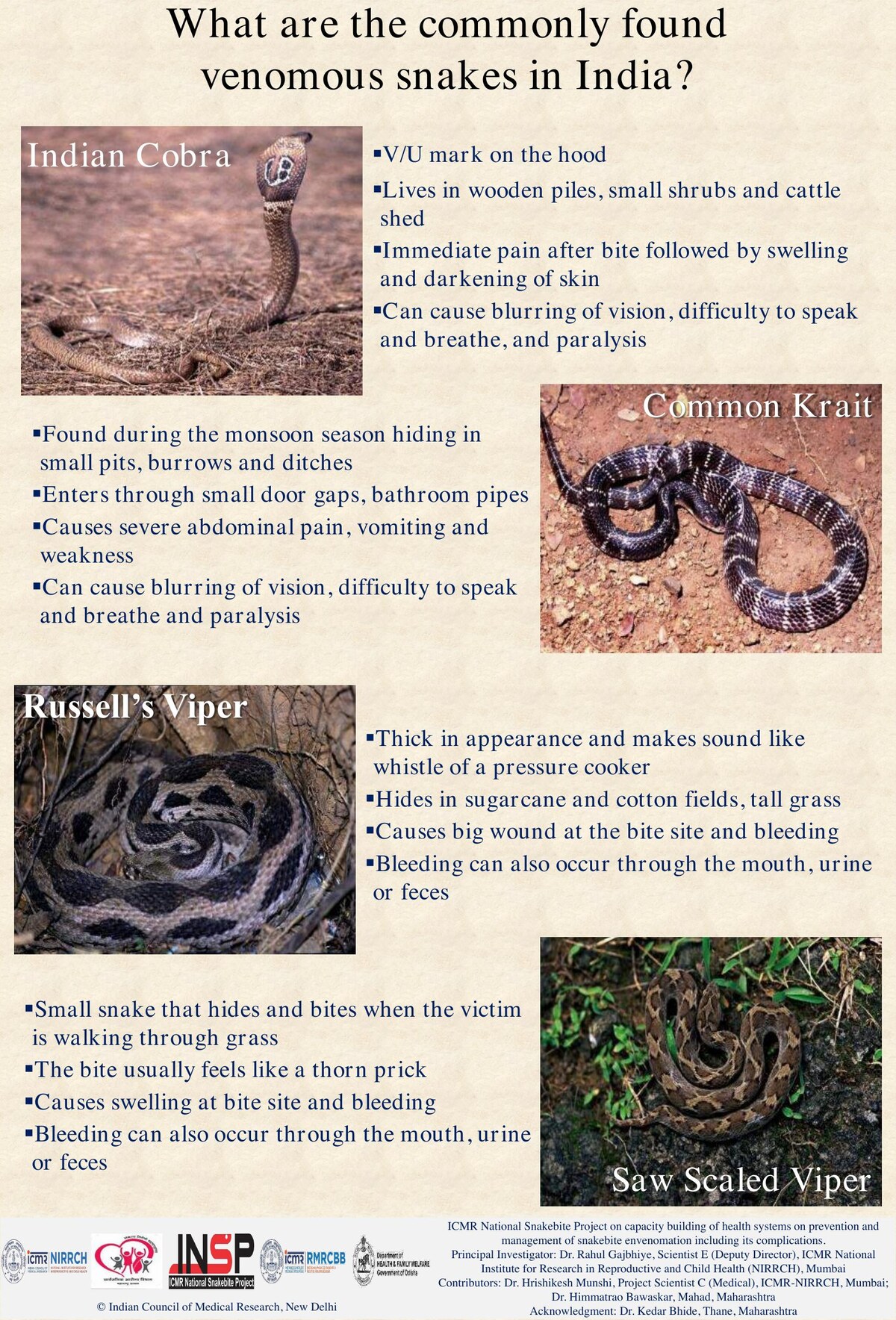
Image-based identification
Government programmes, schemes and services
- Programme: National Programme for Prevention and Control of Snakebite Envenoming: Aims to reduce snakebite deaths, disability and complications by improving first aid, trained treatment, emergency referral, antivenom access, surveillance and community awareness.
- Action plan: National Action Plan for Prevention and Control of Snakebite Envenoming: The 2024 action plan coordinates health services, ambulance/referral networks, venom and antivenom systems, surveillance, research and prevention across sectors.
Prevention
- Prevent: Wear footwear and use a light outdoors at night; keep surroundings clear; after a bite, keep the person still, immobilise the limb and transfer urgently.
Treatment and cure reality
- Treat: Antivenom is the specific treatment for systemic envenoming. Airway support, treatment of shock or coagulopathy, and monitoring for kidney injury may be lifesaving.
Must remember
- Programme: National Programme for Prevention and Control of Snakebite Envenoming; its national action plan was launched on 12 March 2024.
- Indian “big four”: Indian cobra, common krait, Russell’s viper, and saw-scaled viper.
- First aid: Reassure, keep the patient still, immobilise the bitten limb, remove rings/tight items, and transport urgently to a capable health facility.
- Do not: Cut, suck, burn, massage, apply ice/chemicals, or use a tight arterial tourniquet.
- Neurotoxic clues: Ptosis, diplopia, bulbar weakness, respiratory paralysis—classically cobra/krait patterns.
- Haemotoxic clues: Bleeding, incoagulable blood, shock, and kidney injury—classically viper patterns.
- Antivenom: The only specific treatment for systemic envenoming; it is not indicated merely because a harmless snake bit the patient.
- Skin-test trap: Routine skin testing does not reliably predict antivenom reactions and should not delay indicated treatment.
- Nursing priority: Airway and breathing support, rapid referral, monitoring for coagulopathy/renal injury, and preparedness to manage anaphylaxis.